Where Does Tim Hortons Get Its Food? Coffee Beans, Eggs and In-Store Baking Explained
Where does Tim Hortons get its food? The short answer is that some of it comes from Canadian farms, some of it comes from coffee farms overseas, and some of it arrives at the restaurant partly made. The coffee beans, the eggs, the steak and the donuts each follow a different path to your tray.
This guide sorts the public facts from the guesses. It covers the coffee beans, the Canadian eggs, the farm ingredients, the donuts, and what the kitchen makes in the restaurant. Where a detail is not published, this guide says so plainly and shows you how to check it for the item in front of you.
Read it before your next order, and you will know which claims Tim Hortons stands behind, which questions have no public answer, and where to look when you want the ingredient list for one sandwich, wrap or donut at Tim Hortons.
What You Need
- The Tims app on your phone: to check Nutrition and Allergens for one item
- The name of the item you want to check
- A few minutes to read the sourcing facts below
- The Guest Care contact page, if you want a full ingredient list
At a Glance: 7 Steps to Trace Tim Hortons Food
- Start with the coffee beans Tim Hortons buys
- Check the eggs in your breakfast sandwich
- Trace the Canadian farm ingredients on the menu
- Learn how donuts reach your restaurant
- See what the kitchen makes fresh in store
- Ask about MSG, mayo and oil the right way
- Spot what Tim Hortons does not publish
Start with the coffee beans Tim Hortons buys
Tim Hortons brews its coffee from 100% premium Arabica beans, and the chain calls its coffee 100 per cent responsibly sourced. It works with Enveritas, a non-profit, to check coffee farms against economic, social and environmental measures. In the restaurant, coffee is brewed fresh every 20 minutes.
The farm work behind the beans goes back to 2005. Tim Hortons says its partnerships have reached smallholder coffee farming families in Guatemala, Honduras, Colombia, Brazil and Tanzania, touching more than 30,000 farmers and their families. Our coffee questions guide covers blends and cup sizes.
Check the eggs in your breakfast sandwich
Every breakfast sandwich at Tim Hortons in Canada is made with 100% Canadian Grade A large eggs, cracked fresh in the restaurant kitchen. The change rolled out across Canada in early 2021, after test markets checked guest reaction. Tim Hortons buys the eggs through a partnership with Egg Farmers of Canada.
Look for the Egg Quality Assurance mark on Tims breakfast ads. The mark shows the eggs meet national food safety and animal welfare standards. In February 2025 the chain added scrambled eggs, made from the same 100% Canadian freshly cracked eggs, in morning loaded wraps.
Pro Tip: Check the item page in the Tims app before you order. The Nutrition and Allergens section lists what the item contains and what it may contain, and it is the fastest public check for one sandwich or donut.
Trace the Canadian farm ingredients on the menu
In Canada, Tim Hortons says the milk, cream, butter, cheese, eggs and potatoes for its hash browns and wedges come from Canadian farmers and suppliers. The potato wedges are made with Canadian potatoes. The steak is 100% Canadian seasoned beef, through a partnership with Canada Beef.
The newest Canadian claim sits on the holiday menu. Maple Bacon, served with breakfast sandwiches, wraps and Grilled Cheese Melts from 12 November 2026, uses 100% Canadian maple syrup. Tim Hortons also committed in 2021 to a core menu free of artificial colours, flavours or preservatives, as its Tims For Good platform states.
Heads Up: Recipes and suppliers change, and shared kitchen equipment can carry traces of milk, egg, gluten, soy or nuts. Tell the team about allergies before you order, and check the current allergen guide for the item you want.
Learn how donuts reach your restaurant
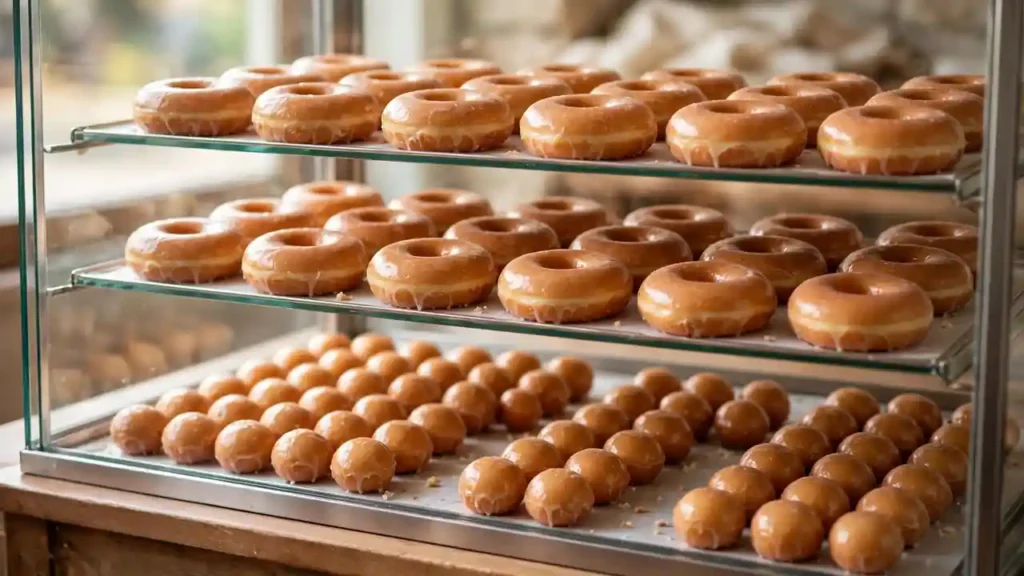
Donuts are not mixed from scratch in the restaurant. They arrive partly baked and frozen from a central bakery in Brantford, Ontario, and staff finish them in the restaurant’s ovens through the day. That is why the case fills up in small batches, and why the morning trays taste freshest.
The switch to this partly baked system was reported in 2003, when donuts stopped being made overnight in each restaurant. Tim Hortons still describes its donuts as hand-dipped and glazed, and that finishing work happens in the restaurant, not at the bakery.
See what the kitchen makes fresh in store
The restaurant kitchen does real work each morning. Eggs are cracked and cooked in the restaurant, sandwiches and wraps are made to order, and donuts are finished in the oven through the day. Coffee is brewed in small batches, with a fresh pot every 20 minutes.
What the kitchen does not do is mix donut dough or bake a full batch from raw ingredients. The partly baked goods arrive ready for their final bake, so the in-store work is finishing, glazing and serving. For first-time picks from that case, our what-to-order guide lists the safest bets.

Ask about MSG, mayo and oil the right way
Tim Hortons does not publish full ingredient lists for its menu items. Nutrition and allergen details sit in the Tims app and on timhortons.ca, under Nutrition and Allergens for each item. For the full ingredient list of one item, Tim Hortons asks guests to contact its Guest Care Team and request it.
That gap is why there is no public answer for the mayo brand, the frying oil or the MSG in one sandwich. In Canada, added MSG must appear on an ingredient list, so the item list is the check. Ask for the list before you order.
Spot what Tim Hortons does not publish
Tim Hortons does not publish a supplier list, so no public page names every company behind the menu. The partners it does name in public are Egg Farmers of Canada, Canada Beef and Enveritas, which checks coffee farms. Recipes and kitchen processes stay private, as they do for most large chains.
Treat a supplier name on a fan site or social post as unverified unless the Tim Hortons newsroom confirms it. The newsroom, the app and the Guest Care Team are the three public checks that carry weight. Anything else is a claim waiting for a source.
Troubleshooting: When a Sourcing Question Has No Public Answer
| Problem | Likely cause | Fix |
|---|---|---|
| I cannot find the ingredient list for one item | Full lists are not published for the menu | Ask the Guest Care Team for that item’s list |
| The app shows nutrition but no ingredients | Ingredients sit behind a Guest Care request | Use Nutrition and Allergens for allergens, then request the rest |
| A site names a Tim Hortons supplier | The chain does not publish a supplier list | Treat the name as unverified unless the newsroom confirms it |
| I read that donuts are baked fresh in store | “Baked” here means finished in store | Donuts arrive partly baked and frozen, then finish in the restaurant oven |
| I want to know if one item has MSG | No public table lists MSG by item | Check the item’s ingredient list, where added MSG must appear |
Frequently Asked Questions
Does Tim Hortons bake in store?
In part, yes. Donuts arrive partly baked and frozen from a central bakery in Brantford, Ontario, and staff finish them in the restaurant’s ovens through the day. Eggs are cracked and cooked in the restaurant, and sandwiches are made to order.
Does Tim Hortons use Canadian products?
For several core ingredients, yes. In Canada, milk, cream, butter, cheese, eggs and potatoes for hash browns and wedges come from Canadian farmers and suppliers, and the steak is 100% Canadian seasoned beef.
Who are Tim Hortons suppliers?
Tim Hortons does not publish a supplier list. The public partners it names are Egg Farmers of Canada, Canada Beef and Enveritas, which checks its coffee farms.
Does Tim Hortons use MSG?
There is no public list that answers this for every item. Full ingredient lists are not published, so check the item’s Nutrition and Ingredients in the app, or ask the Guest Care Team. In Canada, added MSG must appear on an ingredient list.
What mayo and oil does Tim Hortons use?
Tim Hortons has not published the brand or type of mayo or frying oil it uses. The item’s ingredient list, requested through the app or the Guest Care Team, is the only public check.
Are Tim Hortons potatoes Canadian?
Yes. The chain says the potatoes for its hash browns and wedges come from Canadian farmers and suppliers, and its potato wedges are described as made with Canadian potatoes.
Quick Reference Card: Where Tim Hortons Gets Its Food
Coffee: 100% premium Arabica beans, responsibly sourced, brewed every 20 minutes
Eggs: 100% Canadian Grade A large eggs, freshly cracked in the restaurant
Canadian farm goods: milk, cream, butter, cheese, eggs and potatoes
Steak: 100% Canadian seasoned beef, through Canada Beef
Maple Bacon: 100% Canadian maple syrup, from 12 November 2026
Donuts: partly baked in Brantford, Ontario, frozen, finished in store
Ingredients: nutrition and allergens in the app; full lists from the Guest Care Team
Suppliers: no public list; named partners are Egg Farmers of Canada, Canada Beef and Enveritas
Now you know where Tim Hortons gets its food, at least the parts the chain states in public. The coffee is 100% Arabica, the eggs are Canadian and cracked in the restaurant, and several core ingredients come from Canadian farms.
Save this pin for your next Tims run, so you can check one item’s ingredients before you order it.
This guide comes from an independent fan blog and is not affiliated with Tim Hortons. Menus, ingredients and availability vary by restaurant, so check the app or your restaurant before you order.